3000 series aluminum discs are a type of aluminum alloy, primarily composed of aluminum and manganese. They possess excellent corrosion resistance, machinability and formability. Common grades of 3000 series aluminum circles include 3003, 3004, 3104, and 3105. Production processes encompass automated processes such as casting and cold rolling, and customized production is supported.
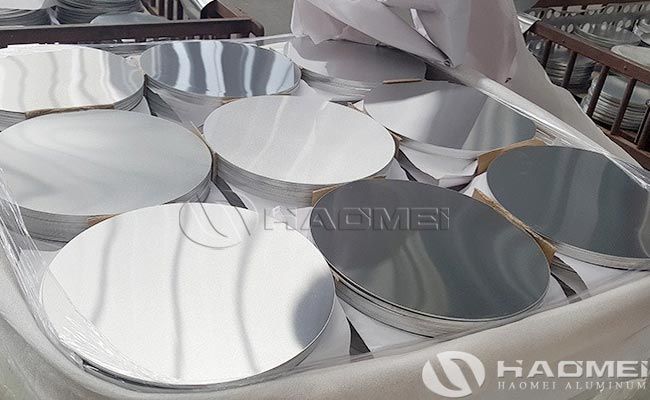
Common grades of 3000 series aluminum circle:
General-purpose rust-resistant aluminum with high plasticity and excellent weldability. Commonly used in high pressure cookers, casings, food processing equipment, etc.
Slightly stronger than 3003 aluminum discs, with excellent corrosion resistance. Widely used in high end cooking utensils , etc.
- 3105 aluminum discs:
Outstanding surface treatment performance and strong weather resistance. Suitable for traffic signs, lighting fixture housings, etc.
The production process of 3000 series aluminum circle utilize casting and cold rolling processes, equipped with a high-precision servo motor drive system, enabling direct feeding of coiled materials, reducing slitting and cross-cutting processes, and lowering the risk of surface damage. Modular mold design supports specification switching within 15 minutes (diameter 85mm-750mm), achieving a production efficiency of 40-55 pieces per minute.
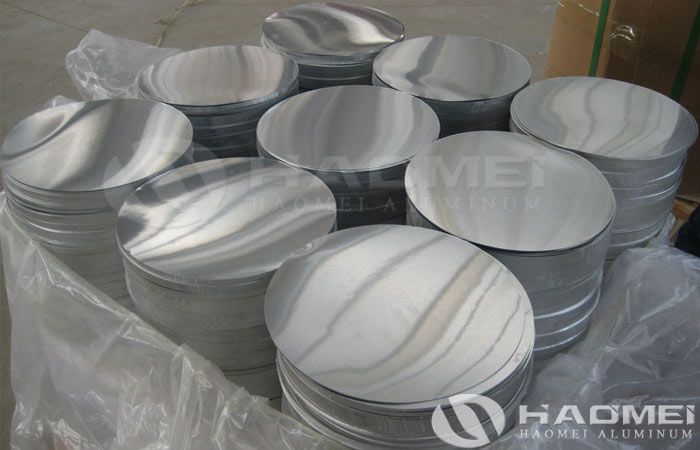
Key quality control points of 3000 series aluminum discs:
Chemical composition: Aluminum content ≥99%, manganese content 0.8%-1.5%, ensuring rust prevention.
Surface quality: Free from cracks, peeling, and corrosion; surface roughness Ra≤0.8μm.
Dimensional accuracy: Thickness deviation ±0.05mm, diameter deviation ±0.2mm, meeting precision machining requirements.
Mechanical properties: Tensile strength 110-283MPa, yield strength 41-248MPa, elongation ≥8%.
Core advantages of 3000 series aluminum discs in cookware:
1. Corrosion resistance:
3000 series aluminum discs use manganese (Mn) as the main alloying element (1.0%-1.5%), forming a dense oxide film (Al₂O₃). This effectively resists corrosion from water, salt, and acidic substances (such as vinegar and lemon juice) in the cooking environment, extending the lifespan of the cookware.
Compared to 1000 series aluminum discs, the 3000 series is less prone to rusting or discoloration in humid and high-temperature environments, making it especially suitable for Chinese cooking where frequent contact with moisture and seasonings is common.
2. Balance of lightweight and thermal conductivity:
Aluminum has a density of only 2.72 g/cm³, about one-third that of iron. Cookware made with 3000 series aluminum discs is lightweight, easy to operate with one hand, and especially suitable for women or the elderly.
Meanwhile, aluminum's thermal conductivity (237 W/m·K) is much higher than that of stainless steel (16 W/m·K), allowing for rapid and even heating, reducing cooking time, and preventing food from burning due to localized overheating.
3. Machinability and formability
The 3000 series aluminum circles possess excellent ductility and plasticity, allowing them to be processed into various cookware shapes (such as frying pans, woks, and saucepans) through stamping, stretching, and spinning processes, ensuring uniform wall thickness and stable cooking performance.
For example, 3003 aluminum discs can be deep-drawn to create seamless pot bodies, avoiding corrosion issues at welded joints and improving overall durability.
4. Surface treatment compatibility
The 3000 series aluminum discs can undergo anodizing, sandblasting, and wire drawing treatments to enhance wear resistance and corrosion resistance, while also improving aesthetics.
For example, anodizing forms a hard oxide film with a hardness of HV300-500, resisting scratches from spatulas; sandblasting increases surface roughness, improving slip resistance.
Typical applications of 3000 series aluminum discs:
1. Non-stick pans
Base material: 3003 or 3004 aluminum discs are used as the base material for the pan body, with a non-stick coating (such as Teflon or ceramic coating) applied to the surface.
Advantages: Lightweight design reduces handling burden; uniform heat conduction prevents coating peeling due to localized overheating; corrosion resistance extends the lifespan of the cookware.
Example: A certain brand of non-stick pan uses 3003 aluminum discs, stamped into shape, with a pan body thickness of 2.5mm and a weight of only 1.2kg, suitable for stir-frying, deep-frying, and other similar operations.
2. Pressure cookers
Base material: 3004 aluminum discs, due to their slightly higher strength than 3003, are commonly used in pressure cooker manufacturing.
Advantages: Lightweight design reduces handling difficulty; corrosion resistance adapts to high-pressure and high-temperature environments; machinability supports the molding of complex structures (such as sealing ring grooves and safety valve holes).
Example: A certain brand of pressure cooker uses 3004 aluminum discs, spun into shape, with a pan body thickness of 3mm, and with a silicone sealing ring, a safe pressure of 80kPa is achieved.
3. Soup Pot/Steamer
Base material: 3105 aluminum circles, commonly used in the manufacture of soup pots and steamers due to its excellent surface treatment properties.
Advantages: Strong weather resistance, no fading over long-term use; surface can be mirror polished for enhanced aesthetics; lightweight design for easy handling.
Example: A certain brand of soup pot uses 3105 aluminum discs stretched and formed, with a pot body thickness of 2mm, and is equipped with a glass lid, suitable for stewing, steaming, and other cooking methods.