Haomei Aluminum's DDQ (Deep Drawing Quality) aluminum circles for cookware are premium deep-drawing substrates engineered for the mass production of cookware requiring high draw ratios. Leveraging comprehensive process control based on DC (Direct Chill) semi-continuous casting, DDQ aluminum circles offer significant upgrades in forming limits, batch consistency, and surface density. They specifically address industry pain points—such as fluctuating yields and post-forming surface defects common with standard deep-drawing materials—and meet the large-scale production demands of high-end, deep-drawn cookware.
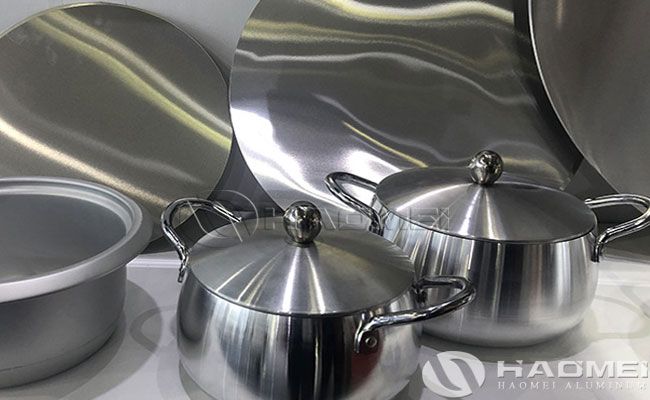
The core quality advantage of these DDQ aluminum circle for cookware lies in their superior forming capabilities and consistent performance. Manufactured from large-format DC cast ingots, the material undergoes homogenization annealing at a constant 480°C for over 12 hours to completely eliminate compositional segregation and internal casting stresses. Combined with high-deformation hot rolling and low-temperature, long-duration recrystallization annealing, the finished product achieves a stable grain size (ASTM grades 6–8) and a uniform, fine microstructure.
In terms of quantitative performance, the 1050 O deep drawing quality aluminum circle exhibits an elongation at break ≥30%, an Erichsen cupping value (IE) ≥10.8 mm, and a limiting drawing ratio (LDR) of up to 2.4:1; the 1100 O DDQ aluminum circle shows elongation ≥28%, cupping value ≥10 mm, and LDR of 2.2:1; and the 3003 O DDQ aluminum circle shows elongation ≥25%, cupping value ≥9.5 mm, and LDR of 2.0:1. Based on my decade-plus experience serving global cookware clients, the total production cost of automated stamping lines depends heavily on material batch consistency; losses resulting from line adjustments and scrap due to performance fluctuations often far exceed the price difference of the material itself. Our DDQ aluminum circle products maintain intra-batch elongation fluctuations of ≤3% and inter-batch performance deviations of ≤2%, eliminating the need for frequent stamping parameter adjustments and ensuring stable operation on high-speed continuous stamping lines.
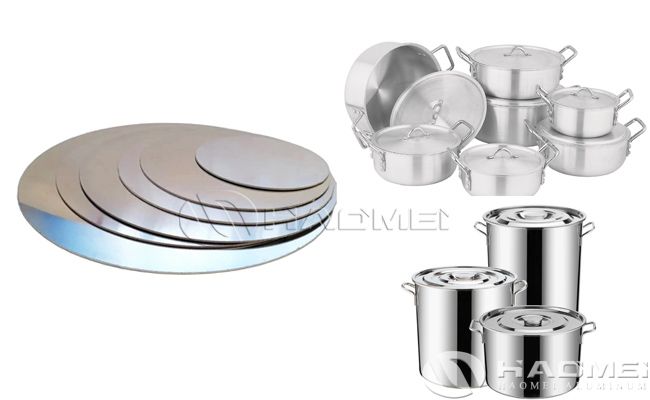
When applied to cookware manufacturing, these DDQ aluminum circles unlock value in the finished product across three dimensions.
First, mass production yields have improved; the overall forming yield for standard deep-drawn cookware consistently exceeds 99%—an increase of 4–5 percentage points compared to conventional deep-drawing materials—thereby significantly reducing raw material waste and rework costs.
Second, the surface quality of the finished product has been enhanced; a uniform, fine-grained microstructure prevents defects such as "orange peel," pitting, and streaking after deep drawing. The post-forming surface roughness (Ra) is ≤0.6 μm, allowing the material to proceed directly to non-stick or ceramic coating processes with coating adhesion consistently meeting Grade 0 standards, effectively extending the service life of the cookware's coating.
Third, compliance regarding food contact safety is better assured; the DDQ-grade aluminum blanks undergo double-sided milling to remove surface segregation layers and subsurface pinholes, resulting in a dense, pore-free surface. Heavy metal leaching (e.g., lead and cadmium) remains far below the thresholds set by international standards such as FDA and LFGB, thereby minimizing compliance risks for exports.
Specific alloys are available to suit various cookware categories. 1050 DDQ aluminum circle offers optimal plasticity, making it ideal for ultra-deep-drawn, thin-walled products like tall milk pans and baby food pots. 1100 DDQ aluminum circle balances strength and formability, serving as a cost-effective choice for mainstream items such as household woks, soup pots, and steamers. 3003 DDQ aluminum circle provides superior strength and corrosion resistance, making it suitable for brazed-base woks, pressure cookers, and large-capacity commercial cookware.
Currently, our factory supplies DDQ aluminum circles for cookware in thicknesses ranging from 0.4 mm to 4.0 mm and diameters from 120 mm to 900 mm. We support the customization of non-standard specifications and special mechanical tempers. Each batch comes with comprehensive material certification and mechanical property test reports, along with specialized moisture-proof and scratch-resistant packaging designed for ocean transport, ensuring reliable supply to cookware manufacturers worldwide.