Consider an aluminum disc with a diameter of 340mm—a specific size often unavailable among standard, off-the-shelf specifications. If a diameter is off by even two or three millimeters, the material may fail to fit into the mold’s feed chamber, forcing the entire stamping line to come to a halt. Custom-diameter aluminum discs are designed to address precisely these challenges: by producing non-standard dimensions directly on the blanking line, we eliminate the need for customers to perform secondary cutting, material splicing, or complex nesting—saving both time and processing costs.
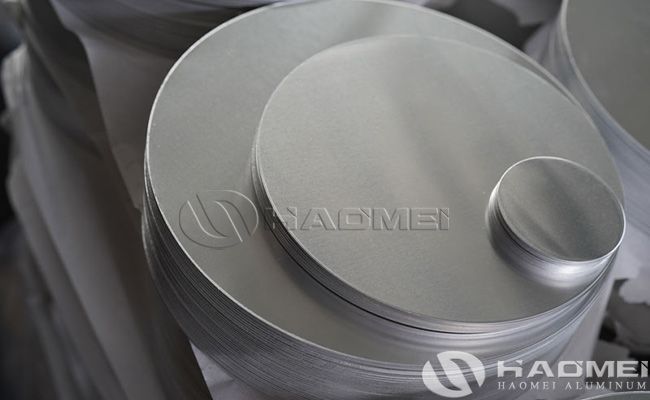
At Haomei Aluminum, our aluminum discs are manufactured from aluminum alloy coils through a process of decoiling, leveling, and continuous blanking. Key quality attributes—such as roundness, concentricity, and edge burr control—are all achieved within a single, integrated production step. Our product range covers 1xxx, 3xxx, 5xxx, and 8xxx series alloys, with commonly supplied grades including 1050, 1060, 1100, 3003, 5052, and 8011. Available tempers include O, H12, H14, H18, H22, H24, and H32. Standard thicknesses range from 0.7 mm to 6.0 mm, with a minimum of 0.5 mm and a maximum of 6.5 mm. Diameters are customized according to your drawings; for the 100–1200 mm range, we utilize modular tooling, allowing for quick changeovers—typically completed within 15 minutes—without the need for dedicated, custom-made dies. We offer both cast-rolled and hot-rolled blanks, with hot-rolled blanks recommended for deep-drawing applications.
Regarding key technical specifications, thickness tolerances can reach as precise as ±0.02 mm, depending on the required accuracy grade. For stamped parts with diameters under 600 mm, the diameter tolerance is controlled within ±0.5 mm. For deep-drawing materials, the grain size is maintained at ASTM grade 6 or finer, and the earing ratio is consistently kept below 3%. Mechanical properties vary significantly by grade and temper: 1060-O (soft temper) features a tensile strength of 60–110 MPa and an elongation of 18–38% (with high-plasticity batches exceeding 32%); 3003-H14 has a tensile strength of 110–185 MPa; and 5052-H32 offers a tensile strength of 215–265 MPa with an elongation of ≥5%. Our entire product line complies with GB/T 3880, ASTM B209, and EN 485 standards, with a density range of 2.71–2.72 g/cm³.
While the diameter is the most straightforward parameter to specify on a drawing, the actual yield rate of stamped parts is primarily determined by three factors: thickness uniformity, edge quality, and the flatness of the aluminum discs. If thickness variation exceeds 0.03 mm, it will be amplified during deep drawing—by the third stage, this manifests as an uneven rim on the cup. If the "earing" rate (anisotropy-induced edge waviness) exceeds 3%, the trimming allowance must be increased, which in turn reduces material utilization. Furthermore, excessive burrs accelerate the wear of die cutting edges and frequently cause material jams on automated assembly lines. It is important to note that when inspecting incoming material, thickness measurements should be taken at least 10 mm away from the edges; measuring too close to the edge with a caliper can result in an artificially low reading due to indentations caused by the blanking process.
Regarding alloy selection:
1060-O aluminum disc offers the best ductility and is the primary choice for food-grade deep-drawn cookware and disposable food containers.
1050 aluminum disc, with a purity of over 99.5%, features excellent electrical and thermal conductivity, making it ideal for lighting reflectors, heat sinks, and signage.
3003 aluminum disc contains manganese for corrosion resistance and offers higher strength than the 1xxx series; it is suitable for traffic signs, storage and transport containers, and components used in humid environments.
5052 aluminum disc—an aluminum-magnesium alloy—balances strength with formability, and is commonly used for pressure vessel end caps, automotive parts, and load-bearing housings.
8011 aluminum disc is primarily supplied in thin gauges and is well-suited for sealing gaskets and bottle caps.
The core value of custom diameter aluminum discs lies in two areas: precise specification matching and batch-to-batch consistency. By aligning the alloy grade with the intended application, the temper with the forming depth, and the tolerances with the requirements of subsequent processing steps, you ensure a smooth and efficient stamping operation. If you require samples with non-standard diameters, mechanical property test reports for specific batches, or food-grade material certification, please contact Haomei Aluminum.