Having exported aluminum discs for over ten years, I've noticed a common selection misconception: many customers either blindly pursue high-purity aluminum or follow trends by choosing high-end alloy grades, rarely paying attention to the compatibility of the alloy composition with their own products. In fact, the formability, corrosion resistance, thermal conductivity, and lifespan of aluminum disc for kitchen use are fundamentally determined by the alloy system. Different grades have clear performance boundaries; choosing the right one can reduce costs and improve product quality, while choosing the wrong one can easily lead to process defects and after-sales problems.
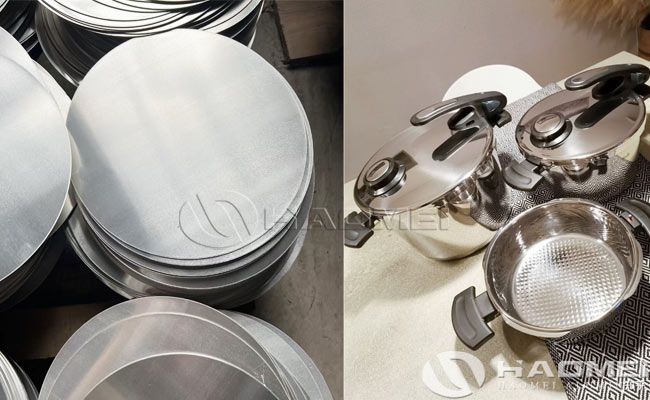
Currently, the mainstream aluminum disc alloys in the global kitchenware industry fall into two main systems, each with clearly defined application scenarios, and there is no absolute superiority or inferiority.
The first type is the 1000 series industrial pure aluminum system, encompassing three mainstream grades: 1050, 1060, and 1100. The core difference lies in the aluminum purity and the proportion of iron and silicon impurities. In terms of performance, higher aluminum purity results in better plasticity and thermal conductivity, but lower strength.
1050 aluminum disc, with a purity ≥99.5%, has a stable elongation in the H0 state exceeding 30% and a thermal conductivity of 230 W/(m·K), making it the optimal choice for deep-drawn thin-walled pots and baby food cookers.
1060 aluminum disc, with a purity ≥99.6%, has performance similar to 1050 aluminum disc but with better batch stability, making it the mainstream choice for mid-to-high-end single-layer aluminum pots.
1100 aluminum disc, with a purity ≥99.0%, contains trace amounts of copper, offering approximately 15% higher strength than 1050 aluminum disc, although its deep-drawing performance is slightly lower, it offers better value for money.
In my personal experience, for ordinary household soup pots and frying pans, there's no need to blindly pursue purity above 99.6%; the performance of 1100 aluminum disc is sufficient to meet needs, reducing procurement costs by 5%-8%.
The second category is the 3000 series aluminum-manganese alloy system, with the 3003 aluminum grade as its core. Solid solution strengthening is achieved by adding 1.0%-1.5% manganese, making it an all-around choice that balances strength, formability, and corrosion resistance. Quantitatively, the tensile strength of 3003-O aluminum disc can reach 95-130 MPa, 30%-40% higher than 1100 pure aluminum disc, with over 40% improved resistance to weak acid corrosion and over 720 hours of pitting-free performance in neutral salt spray tests. Its core advantage lies in its compatibility with brazing processes for composite pot bottoms, its resistance to softening and deformation under high-temperature conditions, and its significantly superior dent resistance and wear resistance compared to pure aluminum. Therefore, it is the standard base material for multi-layered bottom woks, pressure cookers, and large-capacity commercial cookware. Many customers worry about the food contact safety of alloy materials. In fact, compliant 3003 aluminum alloys have extremely low manganese leaching levels, fully complying with FDA and LFGB food contact standards, a fact proven by long-term global market experience.
Customers often inquire whether 5000 series aluminum-magnesium alloys can be used to improve the strength of cookware. Here's a clear statement: it's absolutely not recommended for residential kitchenware applications. Magnesium in 5000 series aluminum alloys poses a risk of leaching during high-temperature cooking, leading to stricter food contact compliance regulations. Furthermore, their plasticity is significantly reduced, making them highly prone to cracking during deep drawing. They are only suitable for a few flat cookware parts, offering extremely poor versatility. Blindly choosing this type will only increase costs and compliance risks.
In Haomei Aluminum's quality control system, the alloy composition of all aluminum discs for kitchen use is strictly controlled within a narrow range: the iron-silicon ratio of 1000 series pure aluminum disc is consistently controlled at 2-3:1 to avoid brittleness during processing; the manganese content of 3003 aluminum disc is precisely locked within the optimal range of 1.1%-1.4%, balancing strength and formability. Each batch of products comes with a material composition test report, with composition dispersion controlled within 0.05%, ensuring consistent performance across batches. We don't blindly recommend expensive alloys to our clients. Instead, we match the most suitable alloy system based on the pot's depth, molding process, usage scenario, and cost positioning. This is the core reason why we can maintain long-term partnerships with most cookware clients worldwide.