3003 aluminum discs are typically quoted in USD per metric ton (USD/MT). Because international aluminum prices, processing fees, and ocean freight costs fluctuate constantly, it is not possible to provide a definitive, fixed price without first confirming specific technical requirements, order quantities, and trade terms. Based on FOB (Free On Board) terms from Chinese port, 3003 aluminum discs prices generally range from $3,600 to $4,200 per metric ton.
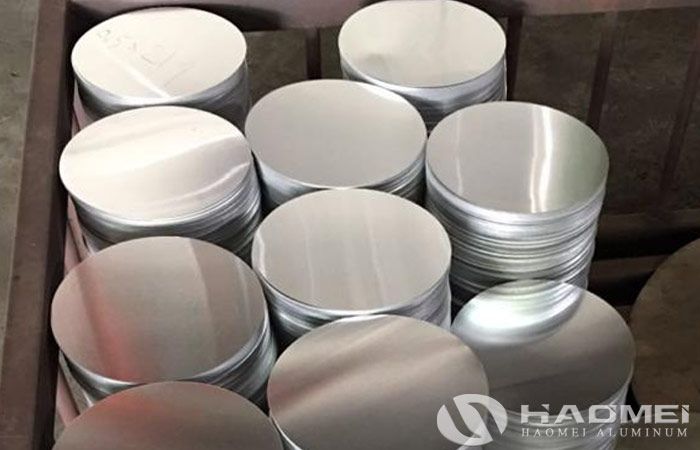
The pricing for 3003 aluminum discs can generally be understood as follows:
Final Price = Base Aluminum Ingot Price + 3003 Alloy Surcharge + Aluminum Coil Processing Fee + Circle Cutting/Stamping Fee + Packaging Costs + Logistics/Shipping Costs. When quoted on an FOB Chinese port basis, the price typically includes export packaging, domestic transport, and port-related charges (subject to the specific trade terms and the details provided in the formal quotation). If quoted on a CIF (Cost, Insurance, and Freight) or CFR (Cost and Freight) basis, ocean freight and related expenses are also included.
Key Factors Influencing the 3003 Aluminum Discs Price
1. Base Aluminum Ingot Price and Settlement Method
3003 is an Al-Mn (aluminum-manganese) alloy. The base price for the aluminum is typically pegged to the London Metal Exchange (LME) price, the Shanghai Futures Exchange (SHFE) price, or another settlement benchmark agreed upon by both the buyer and the seller. Quotes must specify whether the price is based on the spot aluminum price, a monthly average, a "fixed-price" (point-pricing) arrangement, or a locked-in price.
The inclusion of manganese, along with the specific smelting controls and quality management required for 3003 alloy, results in an "alloy surcharge." Consequently, 3003 aluminum discs are generally priced higher than aluminum discs made from pure aluminum (such as 1050 or 1060 grades). The exact price differential varies based on raw material costs and market supply conditions.
2. Thickness, Diameter, and Weight per Piece
The thickness and diameter of the aluminum discs directly affect the rolling, leveling, and stamping processes, as well as the material utilization rate. Thinner aluminum discs require stricter tolerances for thickness, flatness, and stamping quality. Extremely large diameters or non-standard dimensions may reduce material utilization (nesting efficiency), thereby increasing the unit processing cost.
Common specifications in the cookware industry include thicknesses of 0.8 mm, 1.0 mm, 1.2 mm, 1.5 mm, and 2.0 mm, with diameters ranging from 160 mm to 400 mm. Final pricing is calculated based on thickness, diameter, and the weight of each individual blank.
The theoretical weight of a single blank can be calculated using the following formula:
Weight (kg/piece) = 0.00000212 × Diameter² (mm) × Thickness (mm)
For example, a 3003 aluminum blank with a diameter of 300 mm and a thickness of 1.0 mm has a theoretical weight of approximately:
0.00000212 × 300² × 1.0 = 0.191 kg/piece
Actual weight may vary due to thickness tolerances; the specific method for weight-based settlement should be confirmed at the time of ordering.
3. Temper and Stamping/Forming Requirements
3003 aluminum discs are typically supplied in O, H12, or H14 tempers. The O temper is suitable for deep drawing, spinning, and complex forming processes, requiring high standards for annealing uniformity, grain structure, and control of "earing" (anisotropic deformation). The H temper is better suited for shallow stamping or applications requiring greater rigidity.
If the aluminium discs are intended for deep-drawn cookware, pressure cookers, spun lighting components, or products requiring anodizing, the supplier must manage surface quality, edge burrs, grain size, and formability according to the specific manufacturing process. These requirements will influence processing fees and the final price per metric ton.
4. Quantity, Packaging, and Destination
Full-container loads or recurring, high-volume orders can lower unit costs by reducing the need for frequent specification changes, blanking adjustments, and specialized packaging. Conversely, small-batch orders, mixed specifications, the use of interleaving paper, individual protective film, wooden crating, or specialized moisture-proof packaging may result in higher costs.
The destination port will also affect CFR/CIF price quotations. Ocean freight, insurance costs, exchange rates, and destination surcharges must be calculated based on actual shipping schedules and carrier terms; they cannot be represented by fixed prices.
How do you request a quote for 3003 aluminum discs?
To obtain an actionable quote, please provide the following information:
Alloy and temper (e.g., 3003-O, 3003-H14, etc.);
Thickness, diameter, and tolerances;
Intended application (e.g., deep drawing, spinning, stamping, cookware, or lighting fixtures);
Weight per piece or the required number of pieces per metric ton;
Total quantity, the breakdown by specification, and whether material with joints (spliced material) is acceptable;
Requirements for surface finish, edges, burr limits, and packaging;
Trade terms (e.g., EXW, FOB, CFR, or CIF);
Port of loading or port of destination.
Haomei Aluminum can provide quotes based on the thickness, diameter, temper, forming requirements, order quantity, and trade terms for your 3003 aluminum discs. We can also assist in determining the optimal material specifications for your specific manufacturing processes, such as cookware stamping, deep drawing, or spinning.