3003 aluminum circles are made from an aluminum-manganese rust-resistant alloy and are the most widely used core raw material in the global kitchenware manufacturing industry. 3003 aluminum circle for kitchen utensils is manufactured strictly according to aluminum standards such as ASTM B209. With its improved alloy ratio and comprehensive mechanical properties, it has become an upgraded kitchenware material that replaces pure aluminum rcircles, and is supplied in large quantities to kitchenware manufacturers worldwide.
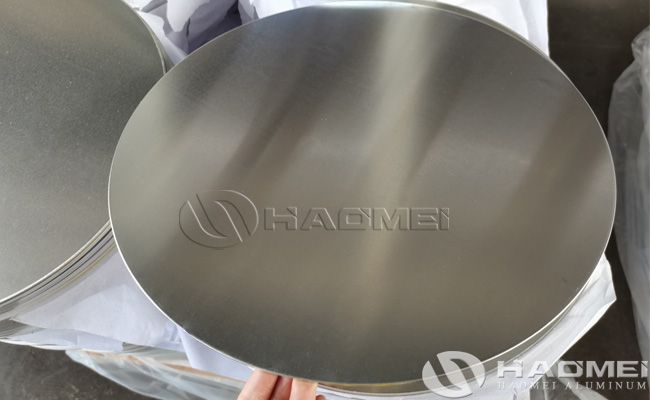
3000 aluminum is primarily an aluminum-manganese alloy, with a manganese content controlled within the range of 1.0% to 1.5%. While retaining the excellent ductility of pure aluminum, it significantly improves the material's corrosion resistance and structural strength. Compared to 1100 pure aluminum circles, 3003 aluminum circles possesses superior resistance to weak acids and moisture corrosion, and can withstand long-term contact with broth, grease, and weak acidic media during cooking, effectively preventing pitting and blackening problems on the inner walls of cookware. Kitchenware manufacturing commonly utilizes two states: O-state and H14. The fully annealed O-state material boasts an elongation rate exceeding 20%, suitable for deep drawing and spinning processes. The semi-hard H14 state offers moderate tensile strength and better rigidity, ensuring cookware, kettles, and other finished products are less prone to deformation over long-term use.
To meet the production needs of the kitchenware industry, our factory implements comprehensive precision control over 3003 aluminum circles. Our standard supply thickness ranges from 0.4mm to 4.5mm, with diameters ranging from 180mm to 900mm. Thickness tolerance is consistently controlled within ±0.02mm, and roundness and flatness indicators are compatible with overseas fully automated stamping and spinning production lines. We use high-precision cast-rolled coils as the base material, undergoing multiple processing steps including leveling, precision slitting, disc punching, and surface finishing. This ensures a smooth surface free of scratches, dents, and burrs, reducing scrap rates in downstream processing and guaranteeing uniform adhesion of subsequent non-stick and ceramic coatings, thus improving the quality of the finished cookware.
Food contact safety is a core requirement for exported kitchenware materials. 3003 aluminum circle has passed FDA, EU food contact material standards. The leaching levels of harmful elements such as lead, cadmium, and arsenic are far below international limits, making it suitable for direct use in all categories of food contact kitchenware, including woks, saucepans, frying pans, kettles, and composite pot bottoms. The surface can be treated with degreasing, mirror polishing, and protective coating according to customer needs. The coated finish effectively prevents oxidation and damage during ocean shipping, making it suitable for long-distance cross-border transportation.
Regarding processing adaptability, the 3003 aluminum circle has a uniform and dense grain structure, making it less prone to wrinkling, cracking, and orange peel texture during deep drawing. It also meets the requirements for deep processing such as brazing and high-pressure lamination. Its overall cost is reasonable, and its performance falls between pure aluminum and high-end alloy aluminum materials, balancing performance and economic efficiency. Leveraging our mature production system and quality control processes, we can customize specifications and mechanical properties according to customer processes, ensuring a stable delivery of various aluminum circle for kitchen utensils, fully meeting the large-scale production needs of cookware manufacturers worldwide.