In the selection of aluminum substrates for cookware manufacturing, DC aluminum circles have consistently been the core material for mid-to-high-end deep-drawn cookware. Many newcomers to the industry often wonder: why is the application penetration rate of DC aluminum circles products in the cookware field much higher than that of ordinary CC aluminum circles, even though both are aluminum circles? The essence is that the production process determines the material properties, and the performance characteristics of DC aluminum circles precisely match the core requirements of cookware forming, surface treatment, and food-grade applications.
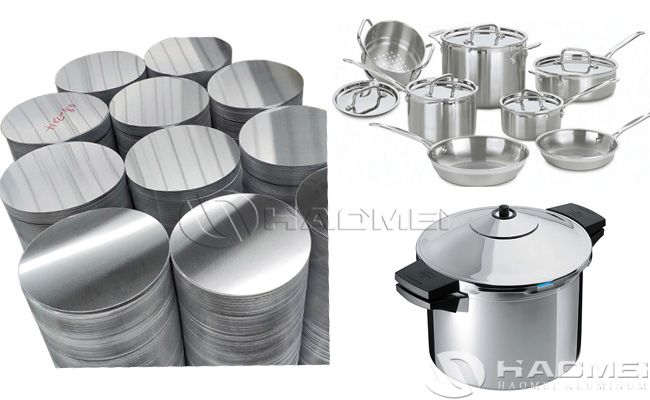
First, it's important to clarify that DC aluminum circles refer to aluminum circles produced using a semi-continuous water-cooled casting (Direct Chill Casting) process: After molten aluminum is first cast into large rectangular ingots, it undergoes homogenization annealing and double-sided milling to remove surface defects, followed by multiple passes of hot rolling, cold rolling, and heat treatment, finally being punched into circles of specified sizes. This long-process technology creates a significant performance difference compared to the short-process continuous casting (CC) aluminum circles.
The core processes in cookware manufacturing are deep drawing and spinning, which require extremely high material plasticity and microstructure uniformity. This is also the core advantage of DC aluminum circles. After casting, DC ingots undergo more than ten hours of high-temperature homogenization annealing to completely eliminate compositional segregation and casting stress. Combined with the grain refinement effect of large-deformation hot rolling, the finished material has a uniform and delicate grain structure. The elongation after fracture in the H0 annealed state can be stably maintained above 28%, and the deep drawing forming limit is significantly higher than that of cast-rolled materials. When producing products with large deformation, such as deep saucepans and milk pots, DC aluminum circles can effectively avoid common defects such as sidewall cracking, rim wrinkling, and orange peel texture on the surface. The scrap rate in mass production can be controlled to within 1%, significantly reducing production losses.
Secondly, the surface quality of DC aluminum circles is more suitable for the coating processes and food contact requirements of cookware. DC ingots undergo double-sided milling before hot rolling to completely remove segregation layers, inclusions, and subcutaneous pores from the ingot surface. This results in a dense, smooth finished disc with minimal microscopic pinholes and porosity, and uniform, controllable surface roughness. This characteristic not only allows non-stick and ceramic coatings to achieve Grade 0 adhesion, extending the lifespan of cookware coatings, but also reduces the risk of heavy metal leaching from surface defects. It also makes it easier to pass international food contact safety certifications such as FDA and LFGB, meeting the stringent quality control requirements for exported cookware.
Furthermore, the batch stability of DC aluminum circles is well-suited to the large-scale mass production needs of the cookware industry. A single DC ingot can weigh several tons, with extremely low dispersion in composition and mechanical properties within the same batch, and performance fluctuations across batches are also kept to a very small range. For automated stamping production lines, stable material properties eliminate the need for frequent adjustments to process parameters, enabling continuous production and reducing debugging costs and quality fluctuations. Simultaneously, the DC process can cover a wide thickness range from 0.4mm to 6mm, adapting to the production of all categories, from thin-walled baby food cookware to thick-walled commercial cookware.
Haomei Aluminum, a professional exporter of aluminum circles, possesses a mature, end-to-end production line for DC aluminum circles, covering commonly used cookware grades such as 1050, 1060, 1100, and 3003. We can customize material properties and surface finishes according to customers' stretching processes and coating requirements. All aluminum circles products have passed international food contact safety testing, and our stable quality helps cookware customers worldwide reduce costs and improve efficiency.