Cookware purchasers often mistakenly believe that aluminum circles are inherently capable of deep drawing. However, in actual production, problems such as sidewall cracking, edge wrinkling, and orange peel texture frequently occur, resulting in high scrap rates. The core misconception lies in confusing the performance boundaries between ordinary aluminum circles and deep-drawing aluminum circles—not all aluminum circles are suitable for deep drawing processes. Only products that meet specific metallographic and mechanical properties can stably withstand large deformation stretching.
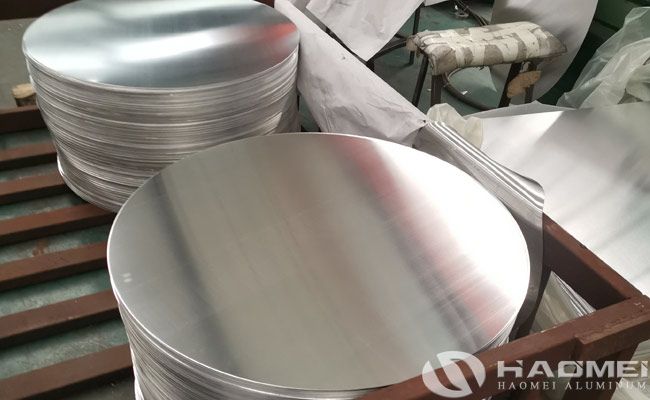
From the perspective of metal forming principles, deep drawing imposes five rigid performance thresholds on aluminum circle, none of which can be omitted.
The first is the elongation threshold, which is a fundamental indicator of deep-drawing performance. Ordinary semi-hard aluminum circles have an elongation of only 8%-15%, suitable only for shallow drawing and flat stamping. Standard deep-drawing grade O temper aluminum circles need to achieve an elongation after fracture of over 28%, with 1050-O aluminum circles actually reaching 30%-35% to support deep forming with a draw ratio of 2.0 or higher and avoid sidewall cracking.
The second hurdle is the ultimate draw ratio (LDR) threshold, a core quantitative indicator for measuring deep drawing capability. The theoretical ultimate draw ratio range for aluminum alloys is 1.8-2.4. Due to compositional segregation, ordinary CC aluminum circles have an actual LDR of only 1.8-2.0; exceeding this will inevitably lead to cracking. Haomei Aluminum deep-drawing grade DC aluminum circles, through homogenization annealing and grain refinement control, achieve an actual LDR of 2.4:1 for 1050-O aluminum circles and 2.2:1 for 3003-O aluminum circles, allowing most conventional deep cookware to be drawn in one step without intermediate annealing.
The third hurdle is the grain size threshold, which directly determines the surface quality after deep drawing. According to ASTM E112 standards, the grain size of deep-drawing aluminum circles must be stably controlled within grade 6-8, without mixed grains or coarse grain defects. Excessively coarse grains will cause orange peel texture after deep drawing, affecting the adhesion of subsequent coatings; excessively fine grains will reduce plasticity and tensile strength. Our factory's deep-drawing aluminum circles products, through precise annealing process control, maintain grain size deviation within ±0.5 grade, resulting in a surface finish Ra ≤ 0.4μm after deep drawing, with no obvious orange peel defects.
The fourth hurdle is the thickness anisotropy coefficient (r-value) threshold. A higher r-value indicates a greater tendency for material to deform in the planar direction rather than thinning, making sidewall thinning and cracking less likely during deep drawing. The r-value for ordinary aluminum circles is approximately 0.5-0.6, while for deep-drawing aluminum circles products, through optimized rolling and annealing processes, the r-value can be increased to 0.7-0.8, effectively reducing sidewall thinning and improving the structural strength of the finished product.
The fifth hurdle is flatness and dimensional accuracy thresholds. Thickness tolerance must be controlled within ±0.02mm, and flatness ≤0.5mm/300mm to ensure uniform stress distribution during deep drawing and avoid forming defects caused by localized stress concentration.
Based on these standards, currently aluminum circles suitable for deep drawing mainly focus on O temper products of 1000 series pure aluminum and 3000 series aluminum-manganese alloys: 1050/1060-O aluminum circle offers optimal plasticity, suitable for extreme deep drawing scenarios; 1100-O aluminum circle balances strength and plasticity, a general deep drawing choice; 3003-O aluminum circle boasts higher strength and better corrosion resistance, suitable for brazing and high-pressure cookware.
Haomei Aluminum's deep-drawing grade aluminum circles all use DC semi-continuous casting blanks, with full-process metallographic structure control. Each batch comes with cupping tests and tensile performance reports. Material states and grades can be customized according to customer drawing ratios and workpiece depths. Currently, it stably serves hundreds of cookware manufacturers worldwide, with a mass production deep-drawing yield consistently above 99%. For material selection and adaptation for your product, please feel free to contact us for technical support and samples.