As a production technician at Haomei Aluminum in China, who has been deeply involved in the aluminum processing industry for over ten years, I have handled countless batches of 3003 aluminum discs production, debugging, and performance testing. I am well aware that deep drawing performance is the core indicator for measuring the quality of aluminum discs and is also the key to winning the trust of global customers. The outstanding performance of 3003 aluminum discs in the deep drawing field is by no means accidental, but rather the precise combination of component ratio, production process, and quality control. This advantage has also enabled its widespread application in many popular export fields.
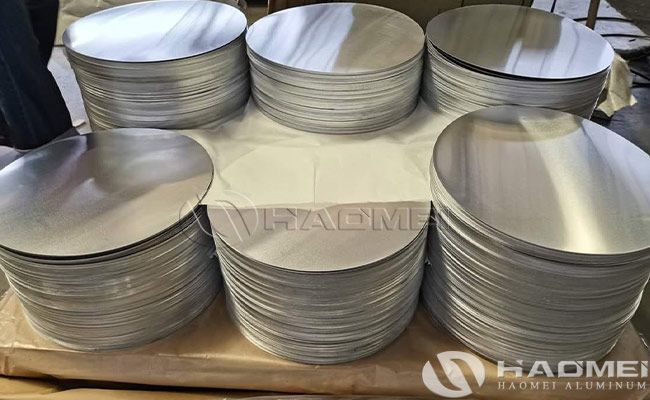
From the perspective of composition, the deep drawing advantage of 3003 aluminum discs stems from its scientific alloy ratio. As an Al-Mn series rust-proof aluminum, we strictly control the manganese content to 1.0%~1.5%, supplemented with a small amount of iron, silicon, and other elements to form a stable solid solution structure, which not only improves the material strength (30% higher than 1xxx series pure aluminum), but also retains excellent plasticity and ductility to the greatest extent. Based on my years of debugging experience, the precise control of manganese is key—excessive amounts will cause the material to harden and crack easily during deep drawing; insufficient amounts will not be able to support complex forming. By repeatedly optimizing the proportion of ingredients, we stabilized the manganese content at about 1.2%, so that the material has both toughness and rigidity. This is also the core reason why it is not easy to wrinkle or tear during deep drawing. At the same time, we strictly control the magnesium content at 0.002~0.005%, effectively avoiding the problem of deep drawing cracking caused by excessive magnesium content in traditional products.
Advanced production technology is an important guarantee for deep drawing performance. In the production process, we adopt a two-stage homogenization treatment. The first stage is heated at 615±10℃ for 9~10h, and then cooled to 445±10℃ in the furnace. Then, the second stage is carried out at 450±10℃ for 8~9h, which effectively refines the grains and controls the average grain size at about 25μm, greatly improving the plasticity of the material. In the subsequent cold rolling process, we control the total processing rate at 80%~91%, and combine it with air cushion continuous annealing at 420~480℃ to keep the material in the O state (fully annealed state). At this time, the material has the lowest hardness and the highest ductility, and can easily cope with complex deep drawing processes such as deep stretching and expansion. In addition, by precisely controlling the ratio of Fe to Si between 1.5 and 3, we reduce the optimal annealing temperature, reduce production energy consumption, and further improve the stability of deep drawing.
The advantages of deep drawing performance make Haomei 3003 aluminum discs the preferred material in many export fields.
In the kitchenware industry, it is the core base material for rice cooker inner pots, non-stick pans, and pressure cookers. During deep drawing, it can form complex arcs in one go, without ears or cracks, and has uniform heat conduction, is non-toxic and environmentally friendly, and meets food-grade standards. When exported to Europe, America, and Southeast Asia, it is highly favored by local kitchenware manufacturers.
In the packaging field, it can be deep-drawn into beverage cans, food cans, and cosmetic cans. After forming, it boasts high dimensional accuracy, with tolerances controlled within ±0.02mm. Its smooth surface makes it easy to coat, adapting to automated production lines and helping customers improve production efficiency.
In the lighting and transportation field, 3003 aluminum discs can be deep-drawn into street light reflectors and traffic sign components. Its lightweight and corrosion-resistant characteristics make it suitable for harsh outdoor environments, and the deep-drawn parabolic reflectors can improve light utilization.
In the automotive parts field, it can be used for deep-drawing to manufacture fuel tanks, water-cooled plates, and other components, reducing vehicle weight while meeting complex forming requirements, aligning with the lightweight trend of new energy vehicles.
Based on export experience, we found that compared to other alloy aluminum discs, the deep-drawing advantage of 3003 aluminum discs helps customers reduce forming processes and lower scrap rates, saving 0.03 yuan per can. This is a key reason for its high competitiveness in the global market.
As a production technician, I firmly believe that good deep-drawing performance is not only a combination of materials and processes, but also a precise grasp of customer needs. Haomei Aluminum's 3003 aluminum discs deep drawing quality, from ingredient ratios to process adjustments, embody our industry experience and craftsmanship at every step. We will continue to optimize our production processes, allowing this deep-drawing advantage to empower more industries globally and showcase the strength of China's aluminum processing industry.